
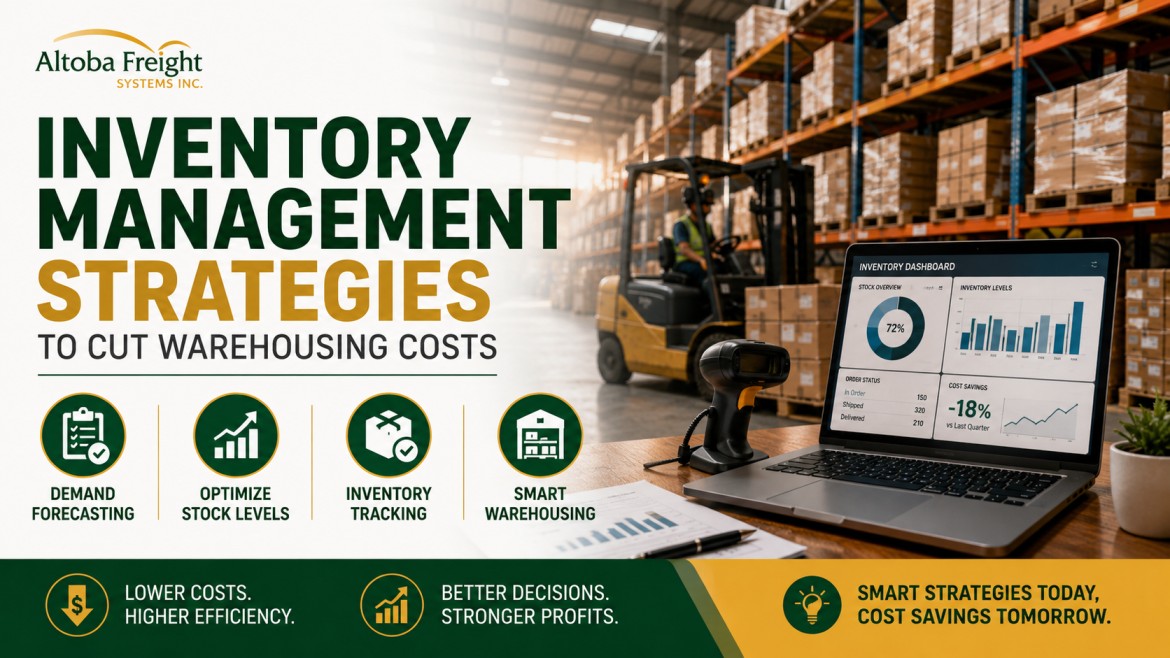
For many Manitoba businesses, warehousing costs quietly creep upward year after year, not because storage rates change dramatically, but because inventory itself is poorly managed. Products sit in the wrong location, stock counts drift from reality, and slow-moving items take up premium space that faster-turning goods could use instead. The good news is that most of these costs are controllable. With the right approach to inventory management, businesses can reduce handling time, free up warehouse space, and get more value from the warehousing solutions they already rely on.
This article looks at what effective inventory management really means inside a warehouse, why it has such a direct effect on cost, and what practical steps businesses can take to tighten up their operations.
What Is Inventory Management in a Warehouse Setting?
Inventory management is the process of tracking, organizing, and controlling stock as it moves through a warehouse, from receiving through storage to outbound shipment. It covers where products are placed, how quantities are counted and verified, how long items sit before they move, and how information about stock levels is recorded and shared.
In a well-run facility, inventory management is not a once-a-year stocktake. It is an ongoing discipline that shapes how efficiently a warehouse operates every single day.
Why It Matters for Warehousing Costs
Warehousing costs are driven by more than square footage. Labour, handling time, equipment use, and error correction all add up, and inventory practices influence every one of them. According to Innovation, Science and Economic Development Canada’s industry data, the transportation and warehousing sector is dominated by small and mid-sized businesses, with 98.2 percent of establishments employing fewer than 100 people. For operations of this size, even modest inefficiencies in inventory handling can have an outsized effect on the bottom line.
Manitoba’s transportation and warehousing sector is also a meaningful part of the provincial economy. Government of Canada labour market data shows the sector employed about 41,200 people in Manitoba and contributed roughly $3.7 billion to provincial GDP, underscoring how much local business activity depends on efficient freight and storage operations. When inventory is managed poorly, the extra labour and space required to compensate ripple through the cost of doing business.
Key Strategies to Reduce Warehousing Costs
- Slotting by demand frequency: Placing fast-moving products near packing and shipping areas, while storing slower-moving inventory farther away, cuts down on unnecessary travel time for warehouse staff.
- Cycle counting instead of annual audits: Regular, smaller counts of specific inventory sections catch discrepancies early and reduce the disruption of a full facility shutdown for stocktaking.
- Setting reorder points based on real demand: Ordering too early ties up space and capital; ordering too late risks stockouts and rush shipping costs. Reorder points should reflect actual sales velocity, not guesswork.
- Reducing dead stock: Products that rarely move still cost money to store. Reviewing slow-moving inventory regularly and clearing it out frees space for products that actually turn.
- Improving receiving accuracy: Errors made when stock first enters the warehouse tend to multiply downstream. Verifying counts and condition at receiving prevents costly corrections later.
- Coordinating inventory data with transportation planning: When warehouse teams and transportation planners work from the same information, shipments can be consolidated and scheduled more efficiently, reducing both storage time and freight costs.
How These Strategies Work Together
None of these practices operate in isolation. Better slotting reduces the labour cost of picking, which supports faster order turnaround. Accurate cycle counts make reorder points more reliable, which in turn reduces the dead stock that eats into available space. Over time, these small, consistent improvements compound into meaningfully lower warehousing costs and a more predictable flow of goods through the facility.
This is also where supply chain solutions that connect warehousing with transportation planning make a real difference. When inventory data flows smoothly between storage and shipping, businesses avoid the added cost of holding stock longer than necessary or scrambling to fill last-minute orders.
What Businesses Should Consider
Before changing how inventory is managed, businesses should look honestly at where their current process is breaking down. Some practical questions to ask include:
- How often do physical counts match system records?
- Which products consistently sit in storage the longest?
- Are receiving errors traced back to a specific step in the process?
- Is warehouse layout based on actual product movement, or on how the space happened to be set up originally?
Answering these questions honestly usually reveals a handful of clear, fixable issues rather than a need to overhaul the entire operation.
Choosing the Right Warehousing Partner
For businesses that store products with a third-party provider, the quality of that partner’s inventory practices matters as much as their rates. A dependable partner should be able to explain how they track stock accuracy, how they organize storage by demand, and how their warehousing services integrate with transportation to keep goods moving efficiently. For Manitoba businesses in particular, choosing a provider with strong warehousing Manitoba experience and regional freight knowledge can help reduce the handling and transit time between storage and delivery.
Frequently Asked Questions
What is the biggest driver of warehousing costs?
Labour and handling time are usually the largest cost drivers, and both are heavily influenced by how well inventory is organized and tracked.
How often should a business perform inventory counts?
Many businesses benefit from ongoing cycle counts rather than a single annual count, since smaller, regular checks catch discrepancies before they grow into larger problems.
Can better inventory management really lower shipping costs too?
Yes. When inventory data is accurate and up to date, businesses can plan shipments more efficiently, consolidate loads, and avoid the rush costs that come with unexpected stockouts.
Is inventory management only important for large businesses?
No. Since most transportation and warehousing businesses in Canada are small or mid-sized, tighter inventory practices can have an even bigger relative impact on smaller operations.
What is dead stock, and why does it matter?
Dead stock refers to inventory that rarely or never sells. It continues to occupy warehouse space and tie up capital, which increases storage costs without generating returns.
Conclusion
Reducing warehousing costs rarely comes down to one big change. It comes from a series of practical improvements, better slotting, more accurate counts, smarter reorder points, and closer coordination between storage and transportation. Together, these steps help businesses get more value from every square foot of warehouse space they use.
Work With Altoba Freight
Looking for reliable logistics, transportation, warehousing, or cross-docking solutions? Contact Altoba Freight to discuss your shipping and supply chain needs.