
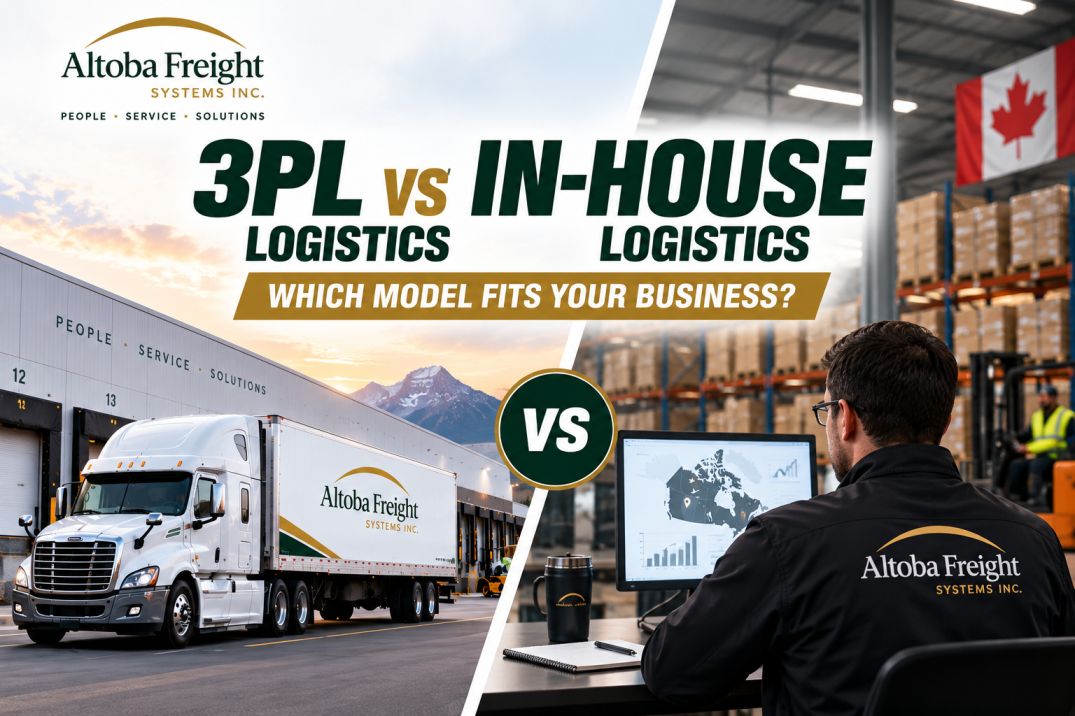
At some point, almost every growing business faces the same question: should we handle warehousing, transportation, and order fulfillment ourselves, or bring in a partner who already has the infrastructure in place? The answer shapes everything from cash flow to how quickly you can respond to a busy season. Choosing between a third-party logistics provider and an in-house operation is one of the most consequential supply chain solutions decisions a company will make, and there is no single right answer for every business.
This article breaks down what each model actually involves, where each one tends to make sense, and what to weigh before committing your budget and operations to one approach.
What Is Third-Party Logistics (3PL)?
Third-party logistics refers to outsourcing some or all of your supply chain functions, such as warehousing, inventory handling, cross-docking, and freight transportation, to a specialized provider. Instead of leasing warehouse space, hiring a logistics team, and negotiating carrier contracts on your own, you plug into infrastructure and expertise that already exists.
A 3PL partner typically manages receiving, storage, order processing, and outbound shipping, and coordinates the transportation needed to move freight efficiently between suppliers, warehouses, and customers.
What Does In-House Logistics Involve?
In-house logistics means a business owns and operates its own warehousing, staffing, equipment, and often its own trucks or shipping arrangements. Every part of the process, from inventory control to delivery scheduling, stays under direct company management.
This model gives a business full visibility and control, but it also means carrying the fixed costs, labour requirements, and operational risk that come with running logistics internally.
Why Does This Decision Matter?
Logistics costs are rarely small. Warehousing, labour, equipment, and freight transportation together often represent one of the largest operating expenses for manufacturers, distributors, and retailers. The wrong structure can quietly erode margins, slow down order fulfillment, or leave a business unable to scale during peak demand.
The right structure, on the other hand, can free up capital, improve delivery speed, and give a business the flexibility to grow without overextending its own operations.
How Today’s Freight Market Affects the Decision
Canada’s freight and trucking market has been shifting through 2026, with capacity tightening after a longer period of oversupply and rate stabilization varying by region and sector. For businesses that own their own fleets or warehouse space, this kind of market movement can mean higher costs to maintain equipment and staff even when shipping volumes dip. Businesses that rely on outsourced transportation and warehousing, by contrast, can often adjust more quickly, scaling capacity up or down as conditions change without carrying the same fixed overhead.
This is one reason many companies revisit their logistics structure periodically rather than treating it as a one-time decision. A model that made sense a few years ago may no longer be the most efficient fit as freight rates, labour availability, and demand patterns evolve.
Key Benefits of Partnering With a 3PL
- Lower fixed costs: No need to lease, staff, and equip your own warehouse space.
- Faster scalability: Ramp up storage or transportation capacity during busy seasons without long-term commitments.
- Access to established networks: A logistics provider often has existing carrier relationships and warehousing infrastructure ready to use.
- Reduced operational burden: Your team can focus on sales, production, and customer service instead of managing freight and inventory.
- Specialized expertise: Providers who focus on warehousing solutions and freight movement daily tend to spot inefficiencies a smaller internal team might miss.
Key Benefits of Keeping Logistics In-House
- Direct control: Full oversight of inventory, staffing, and delivery timelines.
- Custom processes: Easier to build workflows tailored precisely to your product or industry.
- Long-term cost potential: At very high, consistent volumes, owning infrastructure can eventually cost less than paying for outsourced services.
- Brand consistency: Some businesses prefer that every touchpoint, including packaging and delivery, be handled directly by their own team.
What Businesses Should Consider
There is no universal answer, but a few questions can help clarify the right direction:
- How predictable is your shipping and storage volume throughout the year?
- Do you have the capital available to invest in warehouse space, equipment, and staffing?
- How quickly do you need to scale up or down based on seasonal demand?
- Does your team have the expertise to manage freight transportation, compliance, and inventory systems efficiently?
- Would outsourcing free up resources to focus on core parts of your business, such as production or sales?
Businesses with fluctuating volumes, limited warehouse space, or lean operations teams often find that outsourcing to a logistics company Winnipeg businesses already trust can reduce risk while improving service levels. Companies with very stable, high-volume operations and the capital to invest may find that building an in-house team eventually pays off.
Choosing the Right Logistics Solution
For many manufacturers, retailers, distributors, and e-commerce businesses across Manitoba, a hybrid approach works well: keeping core functions in-house while relying on a logistics partner for warehousing, cross-docking, or full truckload transportation during peak periods.
Altoba Freight supports businesses with warehousing solutions, cross-docking services, and freight transportation designed to fit into your existing operations rather than replace them entirely. Whether you need short-term storage during a demand spike or ongoing support with inventory handling and distribution, the goal is to make your supply chain more efficient without asking you to take on unnecessary overhead.
Businesses evaluating Logistics in Winnipeg and the surrounding region should look for a provider with a track record of reliability, transparent communication, and the flexibility to adjust as order volumes change throughout the year.
Frequently Asked Questions
What is the main difference between 3PL and in-house logistics?
3PL means outsourcing warehousing, transportation, or fulfillment to an external provider, while in-house logistics means a business manages all of these functions itself, using its own staff, equipment, and facilities.
Is outsourcing logistics more expensive than doing it in-house?
Not necessarily. While outsourcing involves paying for a provider’s services, it often eliminates the fixed costs of leasing warehouse space, hiring staff, and purchasing equipment, which can make it more cost-effective for businesses with variable or seasonal volumes.
How do I know if my business is ready to bring logistics in-house?
Businesses with consistent, high shipping volumes, available capital for infrastructure, and the internal expertise to manage compliance and freight coordination are generally better positioned to consider an in-house model.
Can a business use both 3PL and in-house logistics at the same time?
Yes. Many businesses use a hybrid model, managing certain functions internally while outsourcing warehousing, cross-docking, or transportation during peak seasons or for specific product lines.
What should I look for in a logistics partner?
Look for proven experience with warehousing and freight transportation, clear communication, flexible capacity, and a service area that matches where your business ships to and from.
Conclusion
Deciding between 3PL and in-house logistics comes down to your business’s volume, capital, and growth plans. Neither approach is universally better, but understanding the trade-offs in cost, control, and scalability makes it far easier to choose a structure that supports your business rather than slowing it down.
Looking for reliable logistics, transportation, warehousing, or cross-docking solutions? Contact Altoba Freight to discuss your shipping and supply chain needs.